Learn how to separate indexability from information gain, find meaningful content gaps, improve AI-assisted drafts with evidence and diagnose excluded URLs in the right order.
A page can be crawlable, return HTTP 200, contain indexable rendered content and declare itself canonical—and still add almost nothing to the search results. This field manual separates technical eligibility from editorial value, then shows how to turn a generic AI-assisted draft into a page with a defensible reason to exist.
The page is eligible. But is it worth keeping?
The draft looks finished. Googlebot is permitted to crawl it, the server returns HTTP 200, the primary content appears after rendering, and no `noindex` directive blocks it. The page even declares itself canonical. One uncomfortable question remains: If this article disappeared, what useful knowledge would searchers lose?
For many AI-assisted drafts, the honest answer is “nothing yet.” They repeat the same advice, examples and cautions already available elsewhere. The sentences may be different, but the underlying information is not.
This exposes two separate gates. The first asks whether Google can discover, crawl, render and consider the URL for indexing. The second asks whether the page makes a relevant, distinct and adequately supported contribution. Neither gate guarantees indexing or ranking.
Information gain in SEO belongs mainly to the second gate. Establish the first before rewriting the article; otherwise, a rendering fault, `noindex` directive or canonical conflict may be mistaken for a content problem.
Two gates, two different diagnoses
Google describes crawling, indexing and serving as separate stages, and not every page reaches every stage. Its minimum technical requirements include Googlebot access, an HTTP 200 response and indexable content. Meeting those requirements makes a page eligible; it does not guarantee inclusion in the index. ([How Google Search works](https://developers.google.com/search/docs/fundamentals/how-search-works); [technical requirements](https://developers.google.com/search/docs/essentials/technical))
The second gate is an editorial framework, not a Google specification. Google’s people-first guidance asks whether content offers original information or analysis, goes beyond the obvious and provides substantial value compared with other results. That supports the underlying principle without establishing a publisher-visible formula. ([People-first content guidance](https://developers.google.com/search/docs/fundamentals/creating-helpful-content))
Do not interpret “Crawled—currently not indexed” as proof of insufficient information gain. It says what happened to the URL, not why one editorial factor caused it. Check the current page, indexability directives, rendering, canonical signals, duplication, site patterns and the date of Google’s last crawl before treating content quality as the leading hypothesis.
| Review gate | What to examine | Useful evidence |
|---|---|---|
| Gate one: Is the URL technically eligible? | Discovery, crawl access, HTTP response, rendered content, indexability directives and canonical signals | URL Inspection, response headers, rendered HTML, robots controls and canonical data |
| Gate two: Does the page add durable value? | Intent fit, novelty, evidence, specificity and practical utility | Baseline map, claim-source matrix, firsthand evidence and editorial review |

What information gain means—and what the patent does not prove
Google LLC is the listed assignee for US11354342B2, “Contextual estimation of link information gain.” The patent records an October 18, 2018 priority date and a June 7, 2022 publication and grant date. It describes implementations that estimate the additional information in an unseen document relative to information from documents already presented to a user. Semantic representations, automated assistants, search interfaces and possible ranking or reranking are among the described implementations. ([US11354342B2](https://patents.google.com/patent/US11354342B2/en))
The comparison is contextual. The patent concerns information already presented to a user, not a universal calculation against the current top ten search results. A SERP comparison can inform editorial research, but it does not reproduce the patented method.
A patent documents a protected invention; it does not confirm use in live Google Search. Publishers cannot retrieve or calculate an official Google information-gain score. Any scorecard used in a content workflow should therefore be labelled an internal editorial heuristic.
A comprehensive article can still have low information gain if it recombines familiar material. A short implementation note may add more value if it documents an important failure condition other guides omit. The test is not merely “Is this new?” It is “Is this new, relevant, supportable and useful?”
Working definition: information gain in SEO is the useful incremental knowledge a page contributes beyond what its intended reader could already obtain. New wording, additional length and a longer list of familiar points do not qualify by themselves.
Map the existing answer before deciding what to add
Begin with the reader rather than the search results. If the job is as vague as “learn about WordPress automation,” almost any missing fact can appear useful. A concrete task reveals which omissions matter.
Suppose existing guides explain connection steps, scheduling and standard benefits. Your map might show little coverage of revision handling, author attribution, duplicate-slug behaviour, rollback procedures or post-publication verification. These are plausible contributions because they affect whether the workflow succeeds—but each still requires evidence.
The map also protects necessary baseline coverage. Information gain does not require making an article unintelligible for the sake of novelty. Explain standard concepts briefly when readers need them, then spend the article’s attention budget on the distinctive contribution.
- Define the reader’s job. State the decision, task or risk in one sentence. For example: “Configure automated WordPress publishing without releasing malformed, duplicated or incomplete posts.”
- Review a representative range of results and the relevant primary documentation. Include different formats and viewpoints; do not let one leading result define the baseline or impose an arbitrary sample size.
- Extract claims rather than headings. Different structures can deliver the same advice. Record repeated claims, recurring examples, disagreements, unstated assumptions and unanswered questions.
- Separate essential context from the proposed contribution. Keep enough baseline explanation for the page to stand alone, but do not inflate it with redundant paraphrases.
- Test each gap for relevance. Retain an addition only if it changes a decision, prevents an error, explains a mechanism or makes the task easier to complete.
- Create a baseline map with three columns: “What the reader must know,” “What existing results already supply” and “What remains unresolved.” Do not commission the draft until the final column contains at least one material, answerable need.
Choose the smallest defensible contribution
A small team does not need a thousand-row study to add meaningful value. Choose the least expensive reliable evidence that resolves a material uncertainty.
Failure modes, counterexamples, local constraints and negative results can be more useful than another list of benefits. An implementation guide adds value when it shows where a standard procedure breaks, how the failure appears and how to verify the repair.
Expert opinion contributes when it reveals experience-based reasoning: what the specialist checks first, which trade-off they accept or why an attractive fix is unsafe. A job title attached to an unsupported assertion is not evidence. Attribute the speaker, establish the relevant experience and distinguish opinion or observation from verified fact.
An update is substantive only when it explains what changed in a primary source, how that affects the process and who needs to act. Changing the publication date on an unchanged summary adds nothing.
- Operational records: anonymized support patterns, correction logs, recurring implementation errors or workflow observations.
- Firsthand observation: a documented setup, interface behaviour, screenshots or limitations encountered during real use.
- Worked analysis: a reproducible calculation, configuration comparison or annotated example with disclosed assumptions.
- Specialist clarification: an attributed interview explaining mechanisms, trade-offs and failure conditions.
- Controlled test: a defined intervention, comparison condition and observation period, with negative or inconclusive findings preserved.
- Original dataset: disclosed collection methods, definitions, sample and limitations—valuable when feasible, but not mandatory.
Workshop: turn a generic AI draft into a useful page
Return to the hypothetical draft about automated WordPress SEO publishing. Its first version promises efficiency, lists familiar features and advises reviewing every post. The statements may be reasonable, but they do not help an operator anticipate failure.
Do not ask the model to “make it more original.” That instruction can produce unusual phrasing or invented specificity. Define a real test instead: name the software and versions, record the date, identify the fields under review, prepare known input states, publish to a controlled environment and document the result. Use product documentation to establish intended behaviour and screenshots or logs to preserve observed behaviour.
The finished article might report whether titles, excerpts, author assignments, images, scheduled times, slugs and canonical declarations transfer correctly. It should show the verification sequence, failures, workarounds and test limits. The conclusion must not exceed the evidence.
Before: “Automated publishing reduces manual work, but always check your settings and content before going live.” Accurate or not, this is interchangeable advice.
After, as a template: “In our [date] test using [versions and configuration], the title and body transferred, while [field] required manual correction. We verified the result in [interface or response], repeated the action [number] times and did not test [limitation].” Every bracket requires an observed fact, not a plausible invention.
The substantive gain comes from the conditions, observation, verification method and limits—not from better synonyms.
| Reader need | Consensus claim | Proposed addition | Source type | Verification | Limitation | Reviewer |
|---|---|---|---|---|---|---|
| Avoiding incomplete automated posts | “Automation saves time and improves consistency.” | A dated test across defined post states showing which fields transferred, which failed and how each result was verified | Firsthand test and relevant product documentation | Not checked / verified / contradicted | Limited to the disclosed versions and configuration | CMS specialist |
| Preventing unintended URL duplication | “Add a canonical tag to handle duplicates.” | A republishing test documenting slug, redirect and declared-canonical behaviour; inspect Google’s selected canonical later if indexed data becomes available | Firsthand observation and Search Console | Not checked / verified / contradicted | The live test cannot predict Google’s canonical selection | Technical SEO reviewer |
Copy this claim-source matrix into the content brief. A row is publication-ready only when the evidence has been checked, its limits are stated and a responsible reviewer is named.
Audit the draft at claim level, not by word count
Apply the scorecard to consequential claims and sections. The labels are editorial judgments: do not total them, publish a percentage or present the result as Google’s score.
Baseline explanations may be only adequate for novelty but strong for relevance and utility. That is acceptable. Compress them to what comprehension requires, then give more space to the verified contribution.
Novel does not automatically mean valuable. An unsupported statistic may be new but weak on evidence. A technical curiosity may be specific but irrelevant. A credible methodology may still be unhelpful if readers cannot understand what decision it supports.
Remove or research sections that are weak across most dimensions. Retain a concise baseline when it keeps the page self-contained. If multiple pages divide useful information across substantially the same intent, consolidation will often produce a stronger resource than another rewrite.
| Dimension | Editorial question | Weak | Adequate | Strong |
|---|---|---|---|---|
| Relevance | Does it help complete the stated task or reduce a material risk? | Interesting but tangential | Related, with limited effect on action | Changes a decision or prevents an error |
| Novelty | What does it add beyond the mapped baseline? | Repeats the consensus | Adds a useful distinction or synthesis | Resolves an unanswered fact, constraint, failure mode or counterexample |
| Evidence | Can the claim be checked, and does the source fit it? | Unsupported, circularly sourced or misattributed | Supported, but indirect or limited in scope | Supported by the best available direct source, a reproducible test or appropriately attributed expertise |
| Specificity | Could another publisher use the statement unchanged? | Generic and interchangeable | Names relevant conditions | Defines the setup, scope, mechanism and limitations |
| Utility | Can the reader apply or interpret it? | No clear action or implication | Provides useful direction | Provides a usable procedure, decision rule or diagnostic |
Put AI-assisted content through a publication gate
Automation can help extract repeated claims, organize sources, compare drafts and flag probable overlap. It cannot assume responsibility for whether evidence is authentic, current or applicable.
Google’s scaled-content-abuse policy focuses on producing many pages primarily to manipulate rankings rather than help users, regardless of how the pages were created. Its examples include using generative AI, scraping search results and stitching together material at scale without adding user value. The policy does not establish an automatic penalty for all AI-assisted content. ([Google spam policies](https://developers.google.com/search/docs/essentials/spam-policies#scaled-content))
Scale magnifies weak controls. One unsupported assumption in a draft is an editing problem; the same assumption repeated across hundreds of pages is a publishing-system problem. Put the gate before scheduling or direct publication.
- Capture provenance during research: source URL, publisher, publication or update date, supported claim and important scope limitations.
- Open primary sources directly. A model summary, search snippet or another article’s citation is a lead, not completed verification.
- Challenge suspicious precision. Check statistics, quotations, product capabilities, dates, version numbers and causal claims.
- Check temporal consistency. Do not describe future events as completed, combine incompatible software versions or present an old observation as current.
- Obtain specialist review when advice depends on implementation experience or could carry legal, medical, financial, security or other serious consequences.
- Inspect the page before release: title, description, headings, internal and external links, media, robots directives, canonical declaration, publish state and structured data where applicable.
- Record the decision. The accountable editor should be able to state what was automated, what was verified, what remains uncertain and why the page is fit to publish.
If the URL is not indexed, troubleshoot in the right order
The URL Inspection tool reports information about Google’s indexed version and can test the current live URL, show a rendered screenshot and expose crawl and canonical data. Its live test does not evaluate every indexing condition, including final canonical selection or all quality-related issues. ([URL Inspection documentation](https://support.google.com/webmasters/answer/9012289?hl=en))
Use the Page Indexing report to identify patterns across groups of URLs and URL Inspection to investigate one page. Neither report proves that a lack of information gain caused exclusion. ([Page Indexing report](https://support.google.com/webmasters/answer/7440203?hl=en))
If the current rendered content is absent, repair rendering before commissioning more research. If canonical signals conflict, resolve them before rewriting the copy. If several URLs satisfy the same intent, consider consolidation rather than expanding all of them.
Only after these checks should insufficient editorial value become the leading content hypothesis. Improve the page because it will better serve readers, not because the change guarantees indexing.
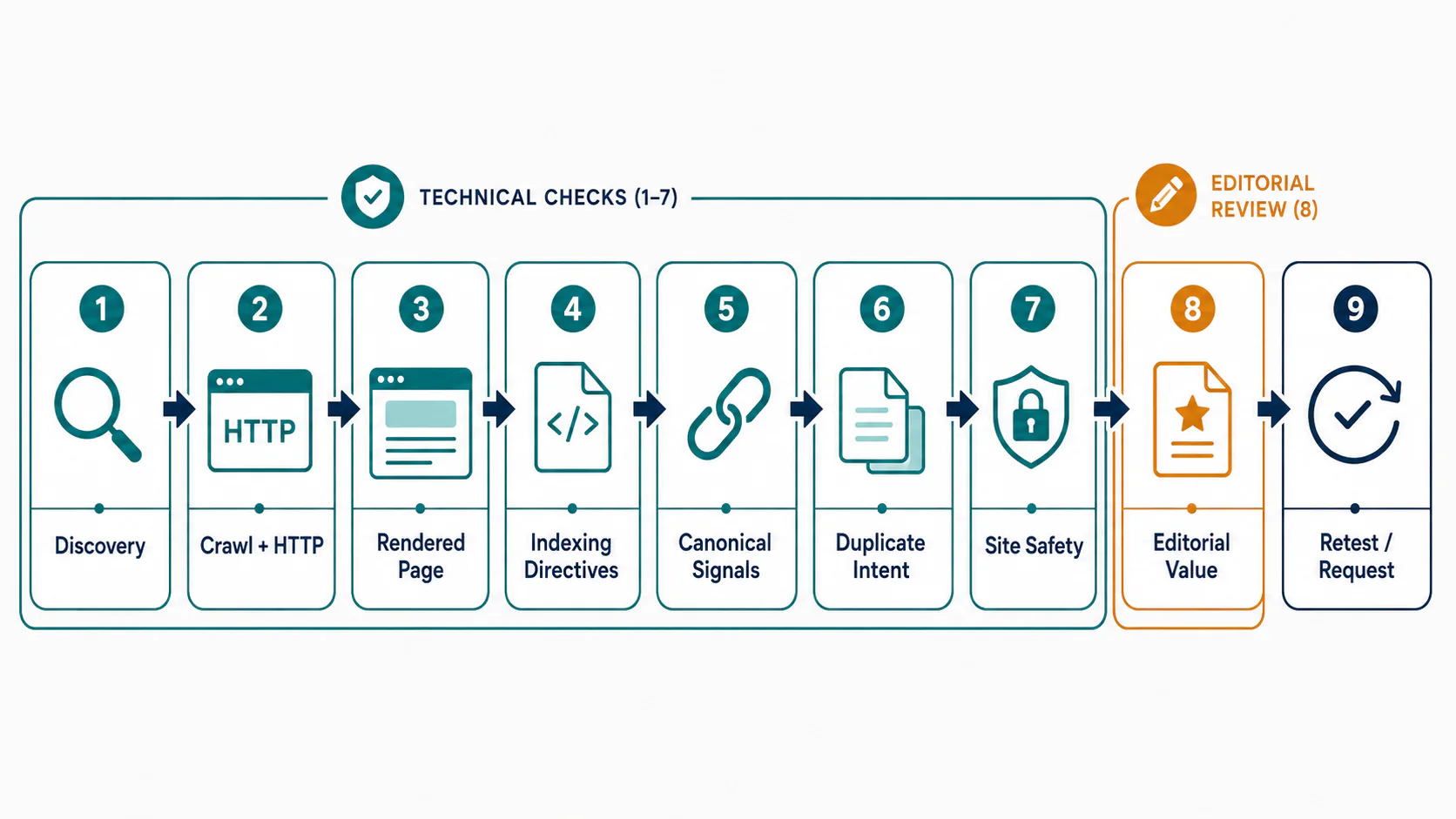
- Confirm discovery. Ensure the URL is linked from a crawlable page or included in the intended sitemap. Sitemap inclusion can aid discovery; it does not prove indexation.
- Confirm access and response. Check that Googlebot is not blocked, no login is required and the final URL returns a genuine HTTP 200 rather than a soft error.
- Inspect the current rendered page. Use URL Inspection’s live test and screenshot to confirm that the primary text and important links are present after rendering.
- Check indexability directives. Inspect robots meta tags and HTTP headers. If robots.txt blocks crawling, Google may be unable to see a page-level `noindex` directive.
- Compare canonical signals. Check the user-declared canonical, redirects, sitemap entries and internal links. The Google-selected canonical is available from indexed data; the live test cannot predict it.
- Assess duplication and intent overlap. Determine whether another URL already represents the same material more coherently.
- Review Manual Actions and Security Issues when the evidence points beyond an individual URL.
- Only then audit editorial value. Look for thin sections, recycled claims, weak evidence and the absence of a distinct reader job.
- After material corrections, test the live URL. Request indexing when appropriate, understanding that this requests crawling and does not guarantee inclusion.
Publish, consolidate or stop: make the final decision
After publication, monitor index status, the Google-selected canonical and the queries producing impressions. Also examine useful engagement, conversions and whether other people reference, link to or cite the distinctive material.
These outcomes may indicate visibility or usefulness. They do not measure the contextual score described in the patent, and none proves that one editorial change caused a ranking movement. Record concurrent changes, compare appropriate periods and preserve uncertainty.
The practical workflow is a sequence: establish technical eligibility, define the reader’s job, map the existing answer, add the smallest defensible contribution, audit important claims and choose the right destination. Sometimes that destination is a new page. Often it is an existing one. Occasionally, the correct decision is not to publish.
- Publish a new URL when it owns a distinct reader job, addresses a distinct intent and contains a verified contribution.
- Update an existing URL when new evidence improves substantially the same answer.
- Merge overlapping pages and redirect retired URLs when there is a clear replacement serving the same intent.
- Use `noindex` when a page genuinely serves users but should not appear in search and can remain crawlable.
- Remove a page with no replacement using an appropriate not-found response. Redirect it only when a relevant successor exists.
- Decline publication when the proposed page has no durable user purpose.
The final test: can the editor name the contribution, show where it came from, state its limitations and explain why it belongs on this URL? If not, the page is not ready.
Information gain is most useful as an editorial discipline, not a ranking-factor claim. It forces a team to separate technical indexing problems from weak differentiation and to support every meaningful addition with evidence, context and limitations. The goal is not to make every article unprecedented; it is to give each indexable URL a clear and verifiable reason to exist.
Apply the two-gate check to one planned or underperforming article. Resolve its technical eligibility, map the existing answer, then add one verified contribution that readers would genuinely miss if the page disappeared.